Showing posts with label AUTOMOBILE. Show all posts

Tuesday, 19 July 2011

REVAi Ride – To Go Electric or Not

In these troubled times of carbon footprints that leave a serious stain on the environment and serious hikes in fuel prices, a car like Mahindra’s REVA could be perceived as beacon of light. This alternative fuel source i.e. electric car made it to our “labs”, in this case, the wild streets of Mumbai, and I was able to get a first hand impression of what a possible “future-car” could be like. Here’s my take on the REVAi, the high-end model.

Design
I’ll be blunt. I’m not a fan of the design. It’s a little too “boxy” for me although it’s quite comfortable inside for two people and two people only. The back set is just about useless for seating, even children, but does add a little boot space to the vehicle. The seats recline quite a bit providing a little ‘snooze’ space if you just want to park and relax for a bit. Since there’s no gearbox, being an automatic car, there’s plenty of leg room. It’s also got quite a bit of head room in the cabin which is essential for those who happen to be in the 6-foot range.
reva_ride_2_191138079922_640x360.jpg
It's cute-ish


The dash is a little too plastic-y and seems just a mite flimsy. Indicators for all purposes are neatly arranged but can get a little confusing if you haven’t read the manual before jumping in. A simple dial system is designed for various driving modes and looks a bit like a dial on a cooking range. There’s – R for Reverse, N for Neutral, F for forward and B for boost. Don’t think of this as some sort of Nitro-Boost feature like you see in the movies or games - this mode throws in about 40% more power, which is quite handy on open roads.

The air conditioner is about the noisiest thing in this otherwise super silent car. Its hum can be a bit distracting. It features a heater as well and a de-fogger for the windshield and rear glass. This version of the REVA is equipped with a Stereo system from JVC that features a CD/MP3 Disc player and radio. Sadly, no USB option. The speakers are just not at par with the player so most times you’ll hear a jarring sound at slightly higher volumes. Bass heavy tracks like most Hip-Hop music really didn’t sound too good. A charging port for your mobile phone et al is also provided. Just above the glove compartment is a pull out cup holder for two cups.
reva_ride_dash_191138077350_640x360.jpg
Platicy dashboard but all relevant features accounted for


Now for the exteriors. Although the car seems a little flimsy it’s designed to be quite a sturdy vehicle. Aside from the Steel space frame and side impact beams, the REVAi also features energy absorbing bumpers and ABS dent-proof body parts. We had to take their word for it as I was not about to drive this rather pricey car into anything or press the shell hard enough to try and dent it. The wiper is rather oddly positioned as it tends to wipe just the central part of the windshield leaving a large part of the bottom portion rather murky when driving in the rain. This tends to inhibit your bumper-to-bumper vision so your judgment will have to be spot on. The headlights although small do tend to provide easy viewing while driving at night.
reva_ride_connector_191138071536_640x360.jpg
Charging port


A charging cable is provided with the vehicle that goes into the little charging port on the left hand side of the car above the rear wheel. It’s positioned in the same place you’d expect to find a fuel tank. I was, admittedly, a little afraid to try and charge the car after driving it in the rains, as the charging port was wet thanks to the absence of a cover. It’s simply placed behind a spring loaded cap that isn’t water tight. I tried it nevertheless and there was no problem. The company also promises to set up a charging post at your residence should you decide to buy the vehicle.

No room in the back


All in all, I have to say, while most women I asked, seemed to think the REVAi was cute, the guys thought it to be a bit un-attractive, although the color of the exterior or the interiors was not the issue. I’ve seen a few other electric vehicles in places like Oslo, Norway, and have to admit those were far sleeker than the REVAi - What you would expect from Euro-designs.

Performance
Now to the nitty-gritty - the REVAi drives like a dream. It’s smooth, peppy and goes from 0 to 40 in just about 7 and a half seconds which is not bad for a small car like this. In traffic it’s got great pick up however the lack of power steering can make maneuverability a little tedious. On the plus side, a small car like this has a good turning radius making it easy to nip in and out of small spaces and take quick U-turns when you need to. Even with two people in the car, pushing her up to 65km/h was easy, but she pretty much caps off at that limit after which things tend to get a little shaky. In ‘Boost’ mode, I was able to get up to 70km/h before things started getting a little ‘out of hand’.


Fuel efficiency-wise, the REVAi is designed to offer you about 80km per full charge. Realistically, she delivered on this front in spades. Even with the AC on and music blaring we managed to squeeze 65km from the REVAi. That’s not bad at all. It takes about 8 hours to charge fully when the battery is drained and can be hooked up to any 15 Amp (220V) socket. The vehicle uses a Power Pack of eight 6-Volt EV type lead acid batteries.

Check out the little test drive video -
 
Mahindra REVAi


Thanks to the onboard computer controlled system, charging will stop as soon as you’re at 100% power so as to avoid your power bill going up. What I was warned about was to avoid taking the car over flyovers as the incline would be responsible for heavy battery drain. There went my highway plans - it meant I had to take the long way home. However, for the sake of putting it through its paces and to do due diligence to the test, I decide the flyovers were the way to go. It does reduce battery power quite a bit but not to the extent that you should avoid them altogether. Of course it’s not a powerful vehicle so climbing isn’t the speediest process.
reva_ride_turn_191138087531_640x360.jpg
Great turning radius


The onboard computer or Energy Management System (EMS) also signals you when you’re running low on juice and immediately switches over to a more efficient mode of energy consumption. So if you’re caught in traffic you’ll be able to pull over to the nearest socket and juice her up. The Five Lakh Rupee question is, who’s going to let you plug your car into their wall socket for an hour or so, so you can get back on your way? The best option is – think of it as a mobile phone that you can simply leave on charge while you’re at work or at home.
reva_ride_standing_out_191138078622_640x360.jpg
Really stands out in a crowd


Overall handling was a breeze even without power steering. The REVAi managed corners quite well and was zippy enough to quickly get from point A to point B within a specific suburb. City driving though is a bit heavy even if you are comfortably sitting in a cool air conditioned car, mainly because of the steering issue. The REVAi also handled the bumps quite well thanks to the Macpherson’s strut in the front coupled with coil spring at the rear to make up the shock absorbers. The regenerative braking system does make braking an easy task. Either ways, it’s not like this car can dish out any serious damage. Nevertheless…
reva_ride_1_191140467253_640x360.jpg
Sweet ride


Central locking with remote locking and unlocking via the provided security system keychain is also part of this high-end model’s sales pitch. It even has an annoying beeper that indicates that the doors aren’t closed properly, or that the hand break lever, which by the way was easier to pull in my Mahindra Two Door Jeep than this, was not released properly.

The Bottom Line
While I liked driving the REVAi and all the attention that came along with it, the price tag of Rs. 4,80,418 (Ex-Mumbai) freaked me out a bit. I’m all for green tech and yes, the technology is expensive, no doubt but as a proof of concept, the REVAi is a thought-provoking idea. As someone once told me, when you have a concept that’s not of the conventional variety, one must accept all the little pitfalls that go with it, keeping in mind its true nature and use. And I couldn’t agree more.
reva_ride_prices_191138085277_640x360.jpg
The price list, click to enlarge


The vehicle may have been around for over 2 years now, but it has evolved considerably since then and who know what we can expect in the next-gen model. Perhaps they’ll heed my cries and we could see options like power-steering, a better music system and maybe even a better design just might make it past the drawing board. Go Green, Go REVA!

Friday, 15 July 2011

Ford Drives the All-New Fiesta Range to India

Popular car manufacturer, Ford, has brought the All-New Ford Fiesta to India. Ford claims that this is perhaps one of the most stylish and aesthetically designed cars in the country. The first among the range of 8 cars has arrived and the rest are expected to follow later.

Among the features that Ford believes has caught the imagination of scores of Indians is the fuel efficiency that the sedan offers, in addition to the other features like cruise control, EPAS, or electric power assisted steering and Advanced Bluetooth Voice Control. Manufactured in Ford’s Chennai plant at Miramalai Nagar, the sedan boasts of having both petrol (1.5 L Ti-VCT) and diesel (1.5 L Duratorq TDCi) fuelled engines.
ford_firsta_test_drive_front_rear_241408508462_640x360_151807406194_640x360.jpg

Ready to roll.. (For more images, click here)


The All-New Ford Fiesta has been enabled with the Anti – Lock Brake System (ABS), electronic brakeforce distribution (EBD), airbags and steering wheel audio controls. Available in Style, Trend, Titanium and Titanium Plus – the styles have been spread across the 8 variants.

The 1.5 L Ti-VCT Style variant comes with a price tag of Rs. 8,31,397, whereas the 1.5 L Duratorq TDCi Titanium Plus variant comes with a price tag of Rs. 10,50,847. We did manage some quality time with the Ford Fiesta, click here  to catch not a glimpse but a meaty video of the Fiesta's voice recognition feature. Also, watch the video below to catch us try the All-New Ford Fiesta:

 
Ford Fiesta Test Drive

Mom Look, it's the Batmobile!

If you're walking down the street and you see something strikingly similar to the Batmobile of 1989, your eyes are not deceiving you! Putsch Racing has adopted the concept from the 1989 Hollywood blockbuster and turned it into reality yet maintaining the similar cosmetic design concept. The car was designed and constructed by Casey Putsch and the most interesting feature is that it is the worlds only turbine powered replica of the Batmobile.
turbinepowered_batmobile_replica_640x360_160920381573_640x360.jpg
Bad guys beware, the Batmobile is gonna prowl the streets!


According to Putsch Racing, it is powered by a Boeing turbine engine from a decommissioned military helicopter. Regarding the car they say, “Putsch Racing has taken the fantasy of movie magic and the power from what was once used to protect our country and combined them into an exercise that inspires bigger dreams and opens creativity.” 

Apart from having the 1989 look, the car sports some modern day technologies such as an iPad on the dashboard serving as an avionics system as well as the ability to keep a track of GPS coordinates. This US-based modification team has also got the car street registered and this is definitely going to turn many more than just a few heads.


Check out the video of the world's only turbine powered Batmobile replica below.


Tuesday, 12 July 2011

The All-New Maruti Swift

swift-2011-110711-06

The country’s largest selling passenger car maker Maruti Suzuki has stopped the production of its highly selling premium hatchback Swift. The reports have stated that this move is to make way for the new version of the Swift, which will be launched in late August or early September.
2011-Suzuki-Swift-in-UK-Dashboard-View
2011-Maruti-Suzuki-Swift-12

Monday, 27 June 2011

Photos: Audi Quattro Concept

Audi Quattro Concept

Audi Quattro Concept

Top Head-Turning Concept Cars at the Paris Auto Show

Audi Quattro Concept
This year’s Paris Auto Show has vehicles of all shapes and sizes, along with a sense of optimism that has been lacking in the industry since the economic meltdown of 2008. How else can you explain an ultra-lightweight Lamborghini, a Jaguar powered by micro-turbine technology, or an Audi that looks ready to go rallying?

Choosing favorites is a highly personal (and often best avoided) undertaking—just ask any parent with more than one child. But there are certain cars that stand out amongst the crowds here at the Porte de Versailles exhibition center. Dramatic styling and high-tech engineering both play a role in our top picks for concept cars we’d most like to see come to market.

In no particular order, here are our favorite concept cars from the Paris Auto Show:

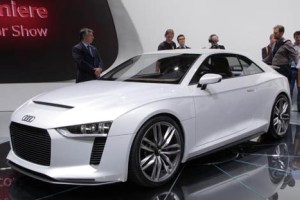
Audi Quattro Concept

Audi reinvented the art of rally driving when the all-wheel-drive Quattro racing car arrived in 1980. Incredibly fast, but with the stability that comes from having four driven wheels, the Quattro was a star of the racing world that spawned, in 1984, the equally legendary road-going Sport Quattro. The only strange thing about the Audi Quattro Concept shown in Paris is why it took the German automaker so long to revive the famous model.

An Audi spokesperson explained that the Quattro Concept’s chassis originally began as the platform for an RS 5 coupe. However, the steel structure was replaced with lightweight aluminum, and the wheelbase shortened by 5.9 in. The chunky-looking, 2-passenger Quattro Concept is powered by a longitudinally mounted 400-horsepower 2.5-liter 5-cylinder (borrowed from the Audi TT RS).

If the Quattro makes it to production—which seems highly likely—expect it to fit between the range-topping TT and base versions of the mid-engine R8.

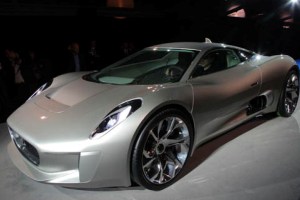
Jaguar C-X75

Jaguar C-X75
We’d love the Jaguar C-X75 even if it were powered by a pair of AA batteries, it’s that good-looking. Incredibly, we overheard some naysayers at the Jaguar stand who questioned the C-X75’s design. Frankly speaking, they’d better visit an optometrist. Jaguar has gotten the shape spot-on with this mid-engine beauty.

Jaguar C-X75Even better, this kitty is more than a pretty face. An electric powertrain is amped up (pun intended) by two gas micro-turbines. Hold on there George Jetson, because the spec sheet only gets better the more you read. The C-X75 has four electric motors—one in each wheel—that deliver the equivalent of 780 bhp and more than 1100 pound-feet of torque.

According to Jaguar’s estimates, the car accelerates from 0 to 62 mph in 3.4 seconds. A 68-mile electric range is boosted by the twin micro-turbines, for a total cruising range of 560 miles. Jaguar officials told us all this tech wizardry is slated for life in a laboratory, at least for several more years of testing.

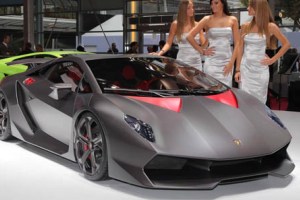
Lamborghini Sesto Elemento

Lamborghini Sesto Elemento
Raw and rude, the Lamborghini Sesto Elemento showcases the Italian sports car company’s use of carbon fiber. This raucously edgy sports car employs a new type of the lightweight material for its central tub called “forged composite.” Lamborghini has rights to the name and a hoard of patents related to this new material.

Lamborghini Sesto ElementoRather than being layered, like traditional carbon fiber, chopped fiber is put into a stamp and (according to Lamborghini officials) the finished chassis tub is complete in only eight minutes. The entire car weighs 2200 lb. It even has carbon-fiber wheels.

A V-10 engine and permanent all-wheel-drive are borrowed from the Gallardo. In terms of overall proportions, the Sesto Elemento has more in common with the “baby Lambo” than the company’s larger, range-topping Murciélago. Lamborghini did coyly tell us it would consider building the Sesto Elemento—strictly a concept car at this writing—so long as the potential owner had deep enough pockets to foot the bill.

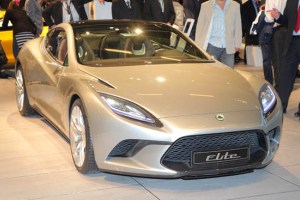
Lotus Elite

Lotus Elite
We’re still scratching our heads over why Lotus decided all the cars it unveiled in Paris needed some celebrity to help pull off the dust cover. Naomi Campbell, Mickey Rourke and Stephen Baldwin looked equally confused as to what they were doing at an auto show—that is, other than collecting a hefty check for a non-speaking role.

Lotus EliteWhen the strangest press conference of the day finally ended, the cars (thankfully) spoke for themselves. While it would be easy to give top marks to the Lotus Esprit Concept, we’ll go out on a limb and give the nod to the Elite. Hey, let’s face it, you expect the 2-passenger Esprit to look like a million bucks…and it does. Job well done, Lotus.

But grafting sporty lines onto a notoriously awkward 2+2 passenger layout is always difficult. Lotus balanced the extra seating and streamlined styling beautifully. The front-engine, rear-drive Elite is powered by a 620-bhp 5.0-liter V-8. An optional KERS hybrid system should also be available when the car goes on sale in 2013.

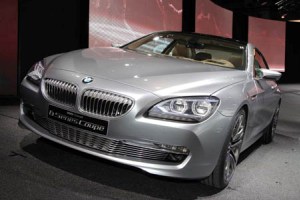
BMW 6 Series Concept

BMW 6 Series Concept
BMW 6 Series ConceptThis big BMW coupe squeaked onto our list, despite some serious reservations about the “concept” part of its name. What you’re looking at is the next 6 Series coupe, plain and simple. And to be honest, we love the end result. The awkward humps and bumps of the previous generation have been smoothed over and modernized.

The rear end of the 6 Series is particularly more refined (i.e., less lumpy) than the previous model. A more aggressive front end and sharp side creases add extra attitude. It might not be a concept in the strict sense of the term, though we can’t argue that the next 6 Series is going to be a looker.

Engine choices will include BMW’s 300-bhp single-turbo inline-6 and twin-turbocharged V-8. A highly tuned version of the turbo V-8 should find its way under the hood of the next M6. Look for the 6 Series to arrive in the U.S. next year, and looking exactly like this concept version.

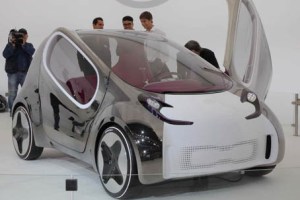
Kia Pop

Kia Pop
To prove that we have sense of humor—and admire a healthy dose of bravery—we simply had to include the Kia Pop electric car. Okay, we’d prefer to see the Lamborghini Sesto Elemento or Jaguar C-X75 parked in our driveway. But if electric cars represent the future, let’s at least have some fun until we get there.

Kia PopWhereas the upcoming Nissan Leaf EV was kept almost painfully bland—so as not to alienate everyone but the hippest of tech-loving early-adopters—the Kia Pop is anything but a shrinking violet, despite its tiny size. Yes, the chrome finish of this concept would make keeping it clean a nightmare. Yet we couldn’t help but smile at those wacky-looking side windows and doors that swing up and out.

The purple interior takes some serious getting used to. So would an estimated top speed of only 87 mph and a driving range of 100 miles. The Kia Pop EV is far from perfect and definitely risky. But isn’t that what concept cars should be all about?

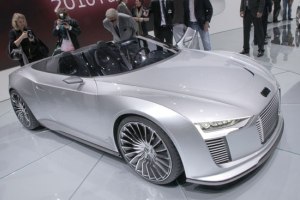
Audi eTron Spyder Concept

Audi eTron Spyder Concept
Audi eTron Spyder ConceptThis is the open-top version of the 2-seat eTron coupe shown earlier this year at Detroit. The Spyder features a cut-down windscreen and is actually a plug-in hybrid with a mid-mounted 300-bhp twin-turbo V-6 diesel to boost power and extend the vehicle’s range. Weighing just 3196 lb., the eTron has two electric motors that propel this sports car to 62 mph in 4.4 seconds, while top speed is electronically limited to 155 mph. In pure electric mode, the eTron has a range of about 30 miles, while the diesel enables the vehicle to travel more than 600 miles before refueling.

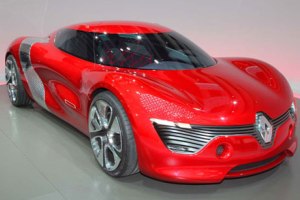
Renault DeZir Concept

Renault DeZir Concept
This first show car from Renault’s new design director Lauren van der Acker is a 2-seat pure electric sports car called the DeZir. The capital Z in the name refers to Renault’s new ZE line of electric motors—in this case it’s a 150-hp unit that accelerates the 1800-lb. car to 62 mph in about 5 seconds. Contributing to the car’s light weight is its Kevlar body, and the sleek shape gives the car an ultra-low 0.25 coefficient of drag. The rear-drive DeZir has a range of about 100 miles between charges. The car is also equipped with a Kinetic Energy Recover System (KERS) developed by the Renault Formula 1 team that provides regenerative braking.

Exagon Furtive-eGT

Exagon Furtive-eGTExagon Furtive-eGT
The latest entry into the range-extended sporty car market is the French-built Exagon Furtive-eGT, which is slated to go into limited production in 2012. Powered by lithium-ion batteries, the Furtive-eGT has an electric-only range of 160 to 250 miles, while an optional gas engine can extend that range to 500 miles. Exagon says the car is capable of 0 to 62 mph acceleration of 3.5 seconds and that the car has a top speed of 178 mph. The company hopes to build about 100 cars a year when it goes into full production. Unlike most EVs that use the motors to directly drive the wheels, the Furtive-eGT uses a 3-speed paddle-shift gearbox attached to a mechanical auto-locking differential.

Wednesday, 15 June 2011

Mercedes-Benz India Launch Mobile Optimized Website


Stylish automotive manufacturer, Mercedes-Benz unveiled its first mobile optimized website in India. The German automotive manufacturer is the first one to do so. Starting from today, smartphone, Android, and other web enabled mobile device users will be able to access the new, optimized website.
Optimized, for ease..


The website, as mentioned before, has been customized specifically for viewing on the mobile device. Designed to function like a virtual car showroom, the website will bring forth a summary of the brand’s corporate website. The optimized website features details on product highlights, technical data, picture galleries, pricing, and other local service details.

According to Mercedes-Benz India, users with the optimized website can:

  • Enter the virtual showroom, or get in touch with the dealers, or ask for brochures and test-drives right from their mobile device.
  • Update themselves with all the news and updates, the brand’s TV commercials, wallpapers, among other services.
  • The optimized site can be accessed from the main website, too since the latter automatically redirects the user to the former.

To view the website, and get a whiff of the features, you can visit - http://m.mercedes-benz.co.in

Wednesday, 1 June 2011

Maruti Suzuki plans to build new plant in Gujarat - reports


MUMBAI (Reuters) - India's top car maker, Maruti Suzuki, is considering to build a factory in Gujarat with a production capacity of one million units, local media reported on Wednesday.
Senior management of Maruti Suzuki met with the Gujarat Chief Minister Narendra Modi on Tuesday and expressed interest to set up a manufacturing plant in the state with an initial investment on 60 billion rupees ($1.3 billion), the Economic Times and Business Standard newspapers said.
Maruti Suzuki could not immediately be reached for comment.
Last year, Maurti Managing Director Shinzo Nakanishi said the company was looking to advance its capacity expansion plans to meet booming demand in the fast-growing south Asian country.
The company, 54.2 percent owned by Japan 's Suzuki Motor Corp, said it was building a second unit in Haryana to add another production capability of another 250,000 vehicles a year, scheduled for completion by April 2012.

Tuesday, 24 May 2011

MV Agusta unveils the F4 RR


The 2012 MV Agusta F4 RR is even more power-packed, faster and lighter than ever before. Not to mention here, it's an MV Agusta!


One of the most revered and sought-after Italian motorcycle brand, MV Agusta has been at the top of the superbike clan for over a decade since it first introduced the absolutely gorgeous and staggeringly fast F4 750 back in 1998. Eight years later the 1000cc F4 followed up in 2006 and took the litre-class by storm. Since then it has been one of the class leading motorcycle with its stupendous performance, sporty yet elegant styling and of course backed by MV Agusta’s race heritage. The Italian marque has now released the new updated and faster MV Agusta F4 RR with an all-new 1000cc short-stroke powerplant to further raise the bar higher than ever before in the superbike world.


Over the years, the F4 has evolved to a great extent and is considered to be one of the most exotic motorcycles in the world. In its latest iteration for 2012 – the F4 RR’s inline-four cylinder engine churns out 201 horses at stratospheric 13,400rpm making it the most powerful production motorcycle in the market today by overtaking the 2011 Kawasaki ZX10R. To match the increased engine output, there is an equally competent chassis design as well as liberal use of exotic parts and materials to keep the costs low. The RR’s engine has been revamped and retuned for further refinement and to extract more performance without hampering its reliability. The engine boasts of lightweight forged pistons built out of lightweight alloy what MV Agusta calls as ‘aerospace RR alloy’. The bore has been increased as well as there is an all-new cylinder head along with a new 4-2-1-4 exhaust configuration with those four gorgeous end pipes peeping underneath the seat. Imagine them singing in accordance at 13,400rpm! Pure symphony.


This is the first time in the history of MV Agusta mass production engines that all the valves are made out of titanium allowing the engineers to drop weight of the motor but increasing the diameter of the inlet and the exhaust tracts. There is a close ratio gearbox that transfers all the 201 horses from the short-stroke motor and the engine/transmission unit is neatly packaged inside lightweight frame. The suspension duties are managed by Ohlins multi-adjustable 43mm telescopic upside-down forks at the front aided by an Ohlins steering damper while on the rear there is an Ohlins TTX 36mm mono-shock suspension.


The radial-mounted disc brakes and the monobloc calipers on the F4 RR come from Italy’s Brembo while the wheel rims are built out of lightweight forged aluminium which reduces the un-sprung weight as well as drops the inertia for better balance and reaction from the motorcycle. First on the 2012 MV Agusta F4 RR are the new adjustable light weight rear sets for improved ergonomics that will be suitable to riders of varying physiques and body structures. With all new graphics to match the bikes improved aggression and grunt, the F4 RR will be available in two colour options including a pastel red/white combination and a matte pearl white.


Specifications: 2012 MV AGUSTA F4 RR 
ENGINE
Type
Four cylinder, 4 stroke, 16 valve
Timing System
“D.O.H.C”, radial valve
Total Displacement
998 cm3 (60.9 cu. in.)
Compression Ratio
13.4 : 1
Starting
Electric
Bore x Stroke
79 mm x 50.9 mm (3.1 in. x 2.0 in.)
Max. horse power - r.p.m. (at the crankshaft)
Full power version: 147,7 kW (200 HP) at 13400 r.p.m. - Lim. 13700 r.p.m. / Restricted power version: 73 kW (100 HP) at 9200 r.p.m. - Lim. 10800 r. p. m.
Max. torque - r.p.m.
Full power version: 114 Nm (11.4 kgm) at 9200 r.p.m. / Restricted power version: 89 Nm (9.0 kgm) at 5800 r.p.m.
Cooling System
Cooling with separated liquid and oil radiators
Engine management system
Magneti Marelli IAW 7BM ignition - injection integrated system with Mikuni throttle body; induction discharge electronic ignition; Sequential timed “Multipoint” electronic injection ; Variable height intake ducts with Torque Shift System (TSS)
Clutch
Wet, multi - disc with mechanical anti-surging device and BREMBO radial master cylinder
Gear Box
Cassette gearbox; six speed, constant mesh
Primary Drive
48/82
Gear ratio (Full power version)

First gear: Speed*
14/37 | 134.1 km/h (83.3 mph) at 13700 r. p. m.
Second gear: Speed*
16/33 | 171.8 km/h (106.7 mph) at 13700 r. p. m.
Third gear: Speed*
18/31 | 205.8 km/h (127.8 mph) at 13700 r. p. m.
Fourth gear: Speed*
20/30 | 236.3 km/h (146.7 mph) at 13700 r. p. m.
Fifth gear: Speed*
22/29 | 268.9 km/h (167.0 mph) at 13700 r. p. m.
Sixth gear: Speed*
21/25 | 297.6 km/h (184.8 mph) at 13700 r. p. m.
Final velocity ratio
15x41
ELECTRICAL EQUIPMENT

Voltage
12 V
Alternator
350 W at 5000 r. p. m.
Battery
12 V - 8.6 Ah
DIMENSIONS AND WEIGHT

Wheelbase
1430 mm (56.27 in.)
Overall Length
2100 mm (82.63 in.)
Overall Width
750 mm (29.51 in.)
Saddle Height
830 mm (32.66 in.)
Min. ground clearance
115 mm (4.52 in.)
Trail
100,4 mm (3.93 in.)
Dry Weight
192 Kg (423 lbs.)
Fuel Tank Capacity
17 l (4.49 U.S. gal.)
PERFORMANCE

Maximum speed*
Full power version: 297.6 km/h (184.8 mph) / Restricted power version: 249.0 km/h (154.6 mph)
FRAME

Type
CrMo Steel tubular trellis (TIG welded)
Rear swing arm pivot plates: material
Aluminium alloy - Adjustable swingarm pivot height
FRONT SUSPENSION

Type
“UPSIDE - DOWN” ÖHLINS telescopic hydraulic fork with rebound-compression damping and spring preload external and separate adjustment
Rod dia.
43 mm (1.69 in.)
Travel on leg axis
120 mm (4.72 in.)
REAR SUSPENSION

Type
ÖHLINS TTX Progressive, single shock absorber with rebound and compression damping and spring preload adjustment
Single sided swing arm: material
Aluminium alloy
Wheel Travel
120 mm (4.72 in.)
BRAKE

Front Brake
Double floating disc with Ø 320 mm (Ø 12.6 in.) diameter, with steel braking band and aluminium flange - BREMBO radial master cylinder
Front Brake Caliper
Radial-type, single-piece with 4 pistons - Ø 34 mm (Ø 1.34 in.)
Rear Brake
Single steel disc with Ø 210 mm (Ø 8.27 in.) diameter
Rear Brake Caliper
With 4 pistons - Ø 25.4 mm (Ø 1.00 in.)
RIM

Front: Material / size
Forged aluminium alloy 3.50 ” x 17 ”
Rear: Material / size
Forged aluminium alloy 6.00 ” x 17 ”
TYRES

Front
120/70 - ZR 17 M/C (58 W)
Rear
190/55 - ZR 17 M/C (75 W)
FAIRING

Material
Thermoplastic
CONTENTS

Steering damper
ÖHLINS - Adjustable damping
Rider’s footrest
Adjustable height